


AI Automation
How to Choose an AI Automation Company in 2026: A Practical Evaluation Framework

A founder we spoke with last quarter had already burned four months and a meaningful chunk of budget on an AI automation agency that delivered a polished demo and nothing that actually ran in production. The bot worked beautifully in the sales pitch. It never touched a real customer ticket. This isn't a rare story. It's closer to the norm.
Research from MIT found that 95 percent of enterprise generative AI projects show no measurable financial return within six months of launch. Separate analysis of over 2,400 enterprise AI initiatives put the failure rate at roughly 80 percent, about double the failure rate of ordinary IT projects. The technology isn't usually the problem. The vendor selection is.
If you're evaluating AI automation services for your business, the questions you ask before signing a contract matter more than any feature list a sales deck shows you. Here's a practical framework for getting it right.
Why So Many AI Automation Projects Fail Before They Even Start
Understanding the failure pattern helps you spot it early, before it becomes your failure pattern too.
Unrealistic expectations set the project up to fail. In a Gartner survey of over 780 infrastructure and operations leaders, 57 percent of organizations that experienced AI failure said they simply expected too much, too fast. A vendor that promises full automation of a complex workflow in two weeks is telling you what you want to hear, not what's realistic.
Weak integration, not weak AI, kills most projects. The most common root causes of failure are poor data quality and shallow system integration, not the underlying AI models themselves. An automation company that hasn't asked detailed questions about your existing systems, your data structure, and your team's workflows before quoting a price is skipping the part of the job that actually determines success.
No one measured ROI in the first place. One 2025 MIT Sloan study found that 61 percent of enterprise AI projects were approved based on projected returns that were never actually measured after launch. Projects with clearly defined success metrics from day one succeed at roughly 54 percent, compared to just 12 percent for projects without them.
Most failures are organizational, not technical. A large share of failed AI initiatives, by some estimates as high as 77 percent, trace back to change management and internal adoption issues rather than the technology itself. An AI business automation services provider that only thinks about the build, and never about training your team to actually use and maintain what they've built, is setting you up for a system nobody touches after month three.
What Actually Separates an AI Automation Company from a Generic IT Vendor
Plenty of software agencies added "AI" to their homepage in the last two years without changing much else underneath. A genuine AI automation company should be able to speak fluently about a few specific things:
- How they design workflows that learn from data and adapt, not just static if-this-then-that scripts
- Which large language models, vector databases, and orchestration tools they actually use in production, not just in a slide
- How they handle data privacy and security when connecting AI systems to your existing business tools
- Whether they've shipped systems that are still running today, not demos built for a single pitch meeting
If a vendor can't answer these clearly and specifically, with real examples, you're likely talking to a generalist wearing an AI label.
A Practical Framework for Evaluating AI Automation Services
Score any agency you're considering against these five areas before you sign anything.
1. Proof of production, not proof of concept
Ask directly: what systems have you built that are running in production today, handling real transactions, for a real client, right now? A strong answer sounds specific, something like a workflow automation platform that cut approval turnaround time by a measurable percentage across a defined number of monthly transactions. A weak answer stays vague and points you toward a generic demo video.
2. Discovery before pricing
A serious artificial intelligence automation solutions provider audits your existing workflows, data quality, and systems before quoting a number. If a vendor gives you a fixed price in the first call without asking about your tech stack, your data, or your actual bottlenecks, that price is a guess, not an estimate.
3. Transparent, deliverable-based pricing
Watch for pricing structures that scale unpredictably, particularly per-seat licensing that becomes expensive as your team or usage grows. Ask whether pricing is milestone-based, tied to specific outcomes, or an open-ended retainer with no clear deliverables attached.
4. Integration depth, not just automation logic
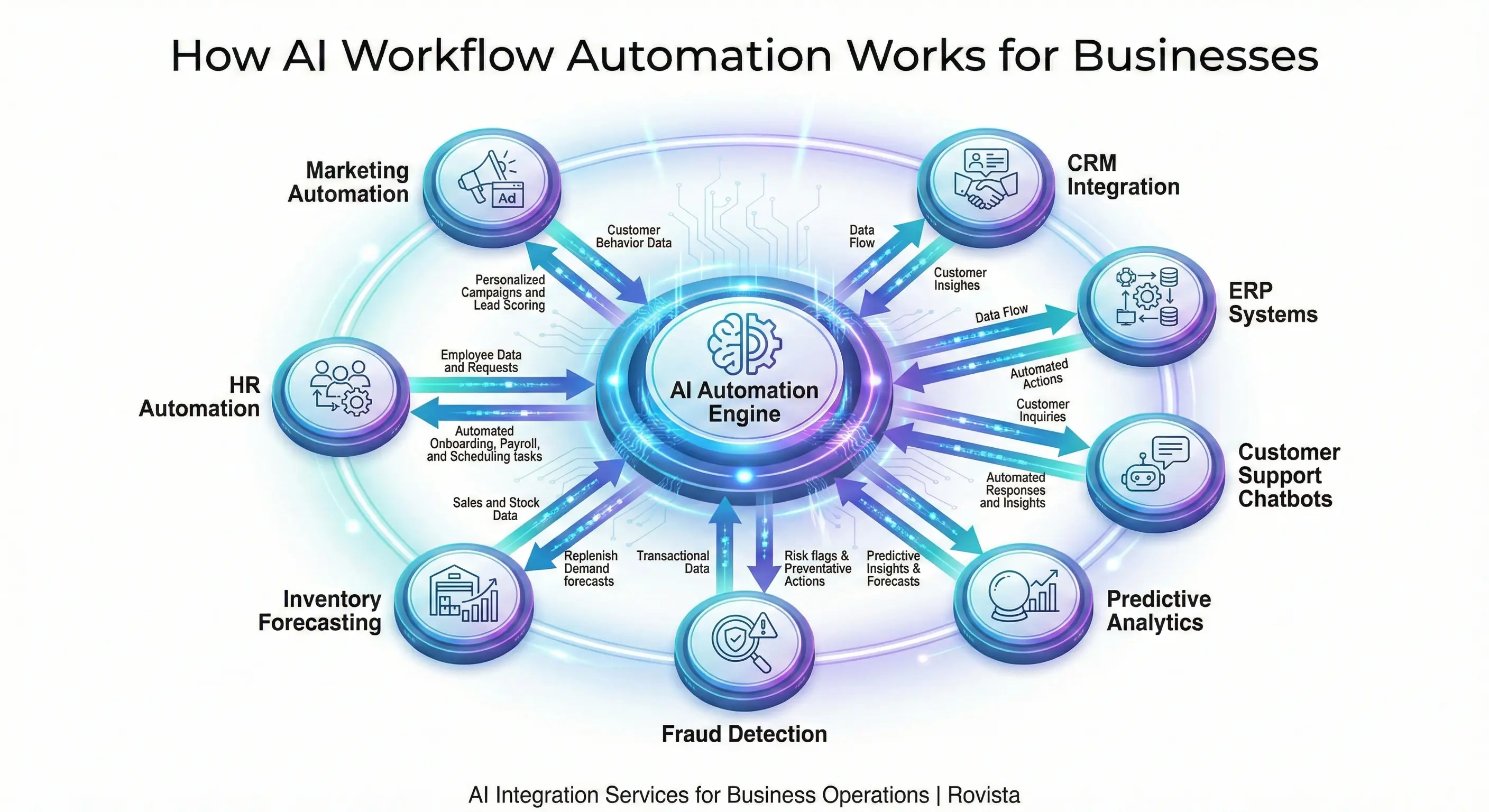
The hardest part of AI automation usually isn't the AI itself, it's connecting it cleanly to your CRM, your ERP, your support desk, and your internal databases without breaking anything. Ask how the agency handles integration with your specific existing systems, not generically.
5. What happens after launch
Ask what ownership and support look like once the project ships. Do you own the models, the code, and the data pipelines outright? Is there a support plan for monitoring and tuning performance after go-live, or does the relationship end at deployment? An automation system that isn't monitored and adjusted after launch tends to degrade quietly until nobody trusts it anymore.
Questions Worth Asking Before You Sign
Bring these into your first real conversation with any AI automation agency:
- Can you show me a system you built that's been live for at least 90 days, with real usage data?
- How do you handle data security and privacy when your AI systems connect to our internal tools?
- What does the discovery and requirements phase actually involve before you start building?
- Who owns the models, code, and workflows once the engagement ends?
- What does ongoing monitoring and support look like after deployment?
A vendor that answers all five with specifics, rather than reassurance, is usually the one worth working with.
What Strong Artificial Intelligence Automation Solutions Should Actually Include
A complete engagement, not just a chatbot bolted onto your website, typically covers:
- Workflow and process automation that replaces manual, repetitive steps with logic that learns patterns over time
- AI integration into existing systems, embedding models into your current software rather than forcing you onto a new platform
- Business automation for reporting and alerts, so data analysis and system triggers happen without someone manually pulling reports
- Predictive analytics, using historical data to flag trends before they become problems
If a proposal only covers one of these, ask whether it's a first phase of a larger roadmap or the entire scope. Both are fine answers, but you should know which one you're getting.
How We Approach AI Business Automation Services at Rovista
We run every engagement through discovery, strategy design, model development and integration, testing, and monitored deployment, in that order, because skipping discovery is where most automation projects go wrong. You can see the full breakdown of our process and capabilities on our AI automation services page, including the specific industries we've built for and the tools we use in production.
Two examples worth a look: an AI-powered workflow automation platform we built to streamline approvals and reporting, and an AI-assisted document processing system with human-in-the-loop validation for enterprise accuracy requirements. Both are live systems, not demos.
If you're specifically looking into building autonomous agents rather than workflow automation, our AI agent development work covers that in more depth, and our page on business process automation breaks down where automation tends to deliver the fastest returns.
Frequently Asked Questions
What is the difference between an AI automation company and a traditional software agency?
An AI automation company builds systems that learn from data and adapt over time, using large language models, machine learning, and intelligent workflow logic, rather than just writing static rule-based code. Ask any vendor which specific AI models and orchestration tools they use in live production systems to tell the two apart quickly.
How much do AI automation services typically cost?
Cost depends heavily on scope, from a single automated workflow to a full AI integration across multiple business systems. Reputable providers usually price based on discovery findings and specific deliverables rather than quoting a fixed number before understanding your systems and data.
How long does it take to see ROI from AI business automation services?
Projects with clearly defined success metrics set before the build starts see meaningfully higher success rates than those without. Realistic timelines for measurable impact are usually a few months post-launch, not weeks, and any agency promising instant transformation deserves extra scrutiny.
What questions should I ask an AI automation agency before signing a contract?
At minimum, ask for a live production example with real usage data, how they handle data security, what their discovery process looks like, who owns the resulting code and models, and what post-launch support is included.
Can artificial intelligence automation solutions integrate with our existing software?
Yes, in most cases. Strong providers design automation to embed into your current CRM, ERP, or internal tools rather than requiring you to replace your existing stack. Integration depth is one of the biggest differentiators between a strong provider and a weak one.
Final Word
The gap between a working AI automation system and an expensive demo almost always comes down to who you hire, not which model they use. Run any agency through the five-point framework above, ask the five questions directly, and pay close attention to how specifically they answer. That's a better predictor of results than any pitch deck.
Want a second opinion on your automation roadmap before committing to a vendor? Book a free strategy call and we'll walk through what a realistic build actually looks like for your business.

Ready to start your project?