


AI Automation
From Pilot to Production: How Enterprises Build Custom AI Agents That Survive Real Workloads

Short answer: A custom AI agent is worth building when a business process involves judgement across multiple systems, happens often enough to justify engineering, and has a checkable outcome. The model is rarely the hard part. What decides success is the quality of your tool integrations, the permissions you give the agent, and whether you built an evaluation harness before you built the agent. Teams that skip that harness ship demos. Teams that build it first ship systems.
Most enterprise agent projects stall in the same place. The prototype handles the demo path convincingly, then meets production data and starts failing in ways nobody can measure. This guide covers how to scope, build and judge custom AI agent development so that does not happen to you.
What an AI agent is, and what it is not
The word agent is used loosely. The distinction that matters commercially is how much of the decision path the software owns.
| Type of system | Who decides the next step | Best suited to | Typical failure mode |
| Rules based automation (RPA, workflow tools) | The developer, in advance | Fixed, high volume, low variance tasks | Breaks the moment inputs vary |
| Chatbot or assistant | The user, turn by turn | Answering questions, retrieving documents | Cannot complete an actual task |
| Retrieval augmented assistant | The user, with grounded answers | Internal knowledge, policy lookup, support deflection | Answers well, still hands work back to a human |
| AI agent | The model, within defined tools and limits | Multi step work across systems, with variance | Silent errors when tools or permissions are weak |
| Multi agent system | A coordinating agent across specialists | Long running processes with distinct skills | Cost and debugging complexity outrun the benefit |
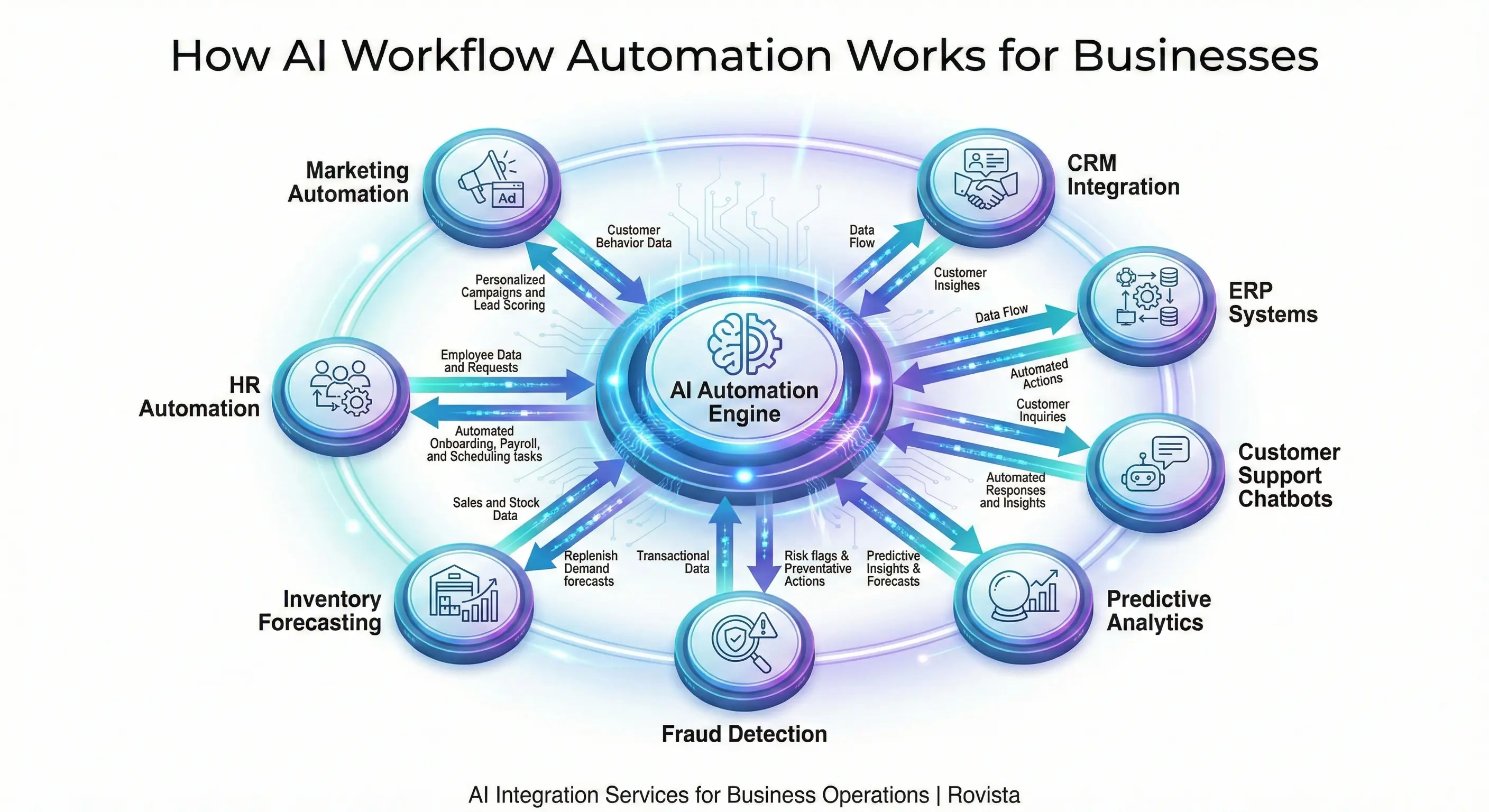
An agent is defined by three things: it has tools it can call, it plans more than one step, and it observes the result of its actions and adjusts. If a system lacks any of those, calling it an agent will only confuse your budgeting.
Deciding what to build: a five question test
Run every candidate process through these before writing code.
- Is the outcome checkable? Can you tell, without human debate, whether the agent got it right? Invoice matched, ticket resolved, record updated correctly. If correctness is subjective, start with a human in the loop design.
- Does it need judgement across systems? Agents earn their cost where a person currently reads from one system, decides, and acts in another. Single system tasks usually belong in normal automation.
- What is the frequency? Below roughly 200 instances a month, the engineering rarely pays back. Above a few thousand, even modest accuracy gains compound.
- What is the cost of a wrong action? A misfiled expense claim is recoverable. A wrongly issued refund or a deleted record is not. This answer determines your autonomy level, not your model choice.
- Do you have the tool surface? Agents act through APIs. If the target system has no API and no clean database access, integration will consume most of the budget.
Processes that clear all five are the shortlist. In practice the highest yield candidates in Indian enterprises tend to be order and invoice reconciliation, support ticket triage and resolution, vendor onboarding checks, claims first pass review, and sales research and CRM enrichment.
The autonomy ladder: choose a level, not a vibe
Most disagreements between a client and an AI agent development company come from an unstated assumption about how much the agent is allowed to do on its own. Naming the level in the statement of work removes that ambiguity.
| Level | What the agent does | Human role | Suitable when |
| 0. Suggest | Drafts an answer or recommendation | Reviews and executes everything | Wrong actions are expensive, or you are still gathering evaluation data |
| 1. Act with approval | Prepares the action, waits for a click | Approves each action | Financial or customer facing actions, early production |
| 2. Act with review | Executes, flags a sample and all low confidence cases | Reviews exceptions and audits samples | Accuracy is proven above your threshold on a held out set |
| 3. Act with escalation | Executes end to end, escalates only when rules or confidence trigger | Handles escalations, monitors metrics | Reversible actions, mature evaluation, clear rollback |
| 4. Manage other agents | Plans and delegates across specialist agents | Owns the outcome and the budget | Only after levels 2 and 3 are running reliably |
The practical guidance is to launch at level 1 and earn the way to level 3 with evidence. Every enterprise agent that failed badly in the last two years was deployed at level 3 with level 0 evidence behind it.
Anatomy of a production grade agent
A working custom agent is roughly 20 percent model work and 80 percent engineering around it. The components below are what separate a system from a script.
| Component | Purpose | Where teams cut corners |
| Tool layer | Typed, documented functions the agent calls, with strict input validation | Wrapping messy internal APIs directly, so the agent inherits every quirk |
| Retrieval layer | Grounding in your documents, policies and records | Dumping a whole document store in without chunking or access filtering |
| Memory and state | Task state, prior steps, conversation and long term facts | Conflating conversation history with durable state, causing loops |
| Planner and control flow | Deciding steps, retrying, knowing when to stop | No step budget, so a stuck agent burns tokens indefinitely |
| Guardrails | Input filtering, output validation, prompt injection defence, permission checks | Relying on the prompt to enforce rules that belong in code |
| Identity and permissions | The agent acts as a scoped service account with least privilege | Giving the agent an admin credential to save integration time |
| Observability | Full trace of every step, tool call, token cost and latency | Logs of the final answer only, making failures undebuggable |
| Evaluation harness | A versioned test set with pass criteria, run on every change | Manual spot checks, so nobody can prove a change improved anything |
| Human handoff | Clean escalation with full context to a person | Escalation that dumps a transcript and no summary |
Two of these deserve extra attention because they are the most common cause of production incidents.
Prompt injection is a real attack surface, not a theoretical one. The moment your agent reads untrusted content, an email, a web page, an uploaded PDF, a customer message, that content can contain instructions. The defence is architectural: treat retrieved content as data and never as instructions, keep destructive tools behind explicit confirmation, scope credentials tightly, and validate outputs against a schema before acting on them.
Least privilege beats clever prompting. An agent that technically cannot delete a record does not need to be told not to delete records. Push safety into permissions and code paths wherever you can, because prompts are guidance and permissions are enforcement.
Enterprise requirements that change the build
Enterprise AI agent development differs from a startup prototype in specific, costable ways.
- Data residency and privacy. Under the Digital Personal Data Protection Act, 2023, personal data you process carries obligations around purpose limitation, consent and breach notification. Decide early whether inference happens in region, what is logged, and what is retained. Logging full prompts that contain customer data creates a new data store you now have to govern.
- Audit trail. For any regulated process, you need to reconstruct why the agent did what it did, months later. That means storing the trace, the retrieved sources, the tool inputs and outputs, and the model version.
- Model portability. Pricing and capability shift constantly. Abstract the model behind your own interface so switching providers is a configuration change rather than a rewrite.
- Access control inheritance. The agent must respect the permissions of the user it acts for. An agent that can read every document is a data leak waiting for the right question.
- Cost controls. Per task token budgets, step limits, caching of repeated retrievals and rate limits. Without these, one looping edge case can produce a memorable invoice.
- Change management. Prompts and tools are production code. They need version control, review and staged rollout, not edits in a console.
A realistic delivery timeline
Custom agent projects run well in short, evidence gated phases. This is a typical 12 week shape for a first production agent.
- Weeks 1 and 2: discovery and process mapping. Shadow the humans doing the work. Document the decision rules they actually use, including the undocumented ones. Identify systems, APIs and data quality gaps.
- Week 3: evaluation set first. Assemble 100 to 300 real historical cases with known correct outcomes, including the messy ones. This is the single highest leverage week in the project, and the one clients most often want to skip.
- Weeks 4 to 6: build the thin path. One workflow, real integrations, level 0 or 1 autonomy, full tracing from day one. Measure against the evaluation set continuously.
- Weeks 7 and 8: hardening. Guardrails, permissions, retries, failure handling, cost controls, human handoff. Adversarial testing including injection attempts through every untrusted input.
- Weeks 9 and 10: shadow mode. The agent runs on live traffic and produces recommendations that a human compares against their own decision. This produces the accuracy evidence needed to raise autonomy.
- Weeks 11 and 12: controlled launch. Level 1 or 2 autonomy on a slice of volume, defined rollback, daily metric review, then a staged widening.
Anyone promising a production enterprise agent in two weeks is describing a prototype. Prototypes are useful, and you should ask for one in the first month, but do not confuse the two in your planning.
Indicative cost of custom AI agent development
Costs vary widely with integration complexity, which is usually the dominant factor rather than the AI itself. The ranges below are indicative market ranges for budgeting, not a quotation.
| Scope | Indicative build cost | What it covers |
| Proof of concept | Rs. 4 lakh to Rs. 10 lakh | One workflow, sandbox or read only integrations, evaluation set, no production hardening |
| Single production agent | Rs. 12 lakh to Rs. 35 lakh | Live integrations, guardrails, observability, human handoff, controlled launch |
| Multi workflow platform | Rs. 35 lakh to Rs. 1 crore plus | Shared tool and eval infrastructure, several agents, role based access, admin console |
| Ongoing run and improve | 15 to 25 percent of build cost per year | Monitoring, eval maintenance, prompt and tool updates, model migrations |
Then there is inference cost, which is operational rather than capital. Budget it per completed task rather than per token, because that is the number your CFO can compare against the current cost of doing the work manually. A useful discipline is to calculate cost per successfully completed task including retries and escalations, then compare it with the fully loaded cost of the human path. Examples of how this arithmetic plays out across different process types are worth reviewing in published client case studies before you set your own targets.
How to evaluate an AI agent development company
Feature lists are interchangeable. These questions are not.
- Show me a trace. Ask to see the full execution trace of a real agent, including a failed run. A team that cannot produce this does not have observability, which means they cannot debug your system either.
- How do you measure quality? The answer should involve a versioned evaluation set, pass thresholds and regression runs. If the answer is that they test manually, expect quality to drift silently.
- What autonomy level do you recommend for this process, and why? A good answer references the reversibility of the actions, not the sophistication of their stack.
- How do you handle prompt injection on untrusted inputs? Look for architectural answers, not prompt wording.
- Who owns the code, prompts, evaluation sets and traces? Get this in writing. Evaluation sets built on your data are a durable asset and should be yours.
- What happens at handover? Ask specifically what your team needs to be able to do without them after six months, and what documentation and training makes that true.
- What have you decided not to build? Vendors who have talked a client out of an unsuitable agent project have judgement. Vendors who say yes to everything are selling capacity.
If you are still shaping the requirement rather than selecting a vendor, a scoping conversation is more useful than a proposal. The broader AI and software engineering services context often reveals that part of the problem belongs in ordinary automation, which is cheaper and more reliable for the deterministic parts.
Five mistakes that kill agent projects
- Building the agent before the evaluation set. Without it, you cannot tell whether any change made things better. Every subsequent decision becomes opinion.
- Choosing a process with no checkable outcome. If correctness is a matter of taste, you will never be able to raise autonomy or prove value.
- Treating integration as an afterthought. In most projects, connecting to legacy systems consumes more effort than everything AI related combined. Scope it first.
- Over-granting permissions to move faster. Broad credentials during development have a way of surviving into production.
- Reporting demos instead of metrics. Leadership confidence built on impressive demonstrations collapses the first time a real failure surfaces. Metrics build slower and hold.
The metrics that actually prove value
Track outcomes, not activity. Token counts and message volumes tell you nothing about business impact.
- Task completion rate without human intervention, measured on the evaluation set and on live traffic separately
- Accuracy on the held out set, tracked by version so you can see regressions
- Escalation rate and the reasons behind escalations, which is your improvement backlog
- Cost per successfully completed task, including retries, compared with the manual baseline
- Cycle time from request to resolution, which is often the benefit users notice first
- Containment of harmful actions, meaning attempted out of policy actions blocked by guardrails rather than by luck
Frequently asked questions
What is a custom AI agent?
A custom AI agent is software that uses a language model to plan and carry out multi step tasks in your own systems, through defined tools and permissions, with an evaluation and guardrail layer around it. Unlike a chatbot, it completes work rather than answering questions about it.
How is an AI agent different from RPA?
RPA follows a fixed script and breaks when inputs vary. An agent decides its next step based on what it observes, which lets it handle variation, but it also needs evaluation and guardrails that RPA does not. Many strong systems combine both, with the agent handling judgement and deterministic automation handling the repeatable steps.
How long does it take to build an enterprise AI agent?
A useful prototype takes two to four weeks. A production agent with real integrations, guardrails and observability typically takes 10 to 14 weeks, with most of that time spent on integration and evaluation rather than on the model.
How much does custom AI agent development cost in India?
Indicative ranges are Rs. 4 lakh to Rs. 10 lakh for a proof of concept, Rs. 12 lakh to Rs. 35 lakh for a single production agent, and upward of Rs. 35 lakh for a multi workflow platform, plus annual run and improve costs of roughly 15 to 25 percent of the build. Integration complexity is the biggest variable.
Should we build in house or hire an AI agent development company?
Build in house if you already have engineers with production agent experience and the observability tooling to support them. Bring in a partner for the first one or two agents, with an explicit handover requirement, then absorb the pattern internally. The lasting asset is your evaluation sets and tool layer, not the vendor relationship.
Are autonomous AI agents safe for customer facing processes?
They can be at the right autonomy level. Start with the agent preparing actions for human approval, measure accuracy on real cases, and only move to independent execution for actions that are reversible and monitored. Irreversible financial or legal actions should stay behind human approval regardless of measured accuracy.
Which model should we use?
Choose per task, not per project, and keep the choice swappable. Route straightforward classification and extraction to smaller cheaper models, and reserve stronger reasoning models for planning steps. Locking your architecture to a single provider is the more consequential mistake than picking the wrong model this quarter.
What if our data is not ready?
Most enterprise data is not ready, and that is normal. Scope a data readiness phase honestly rather than pretending the agent will compensate. An agent reading inconsistent records will produce inconsistent decisions, faster than a human would.
Next step
The most useful first conversation is not about models. It is about one process: how it works today, what a correct outcome looks like, how often it runs, and what a wrong action costs. Bring those four answers and the scope becomes clear within an hour. When you are ready, start a scoping conversation with a specific process in mind rather than a general interest in AI, and ask for the evaluation approach before you ask for the architecture.
Written by the Rovista engineering team from production AI agent deployments. Cost figures are indicative market ranges for budgeting purposes and are not a quotation.

Ready to start your project?