


AI Automation
Custom AI Agent Development: What It Actually Takes to Build an AI Agent That Works in Production
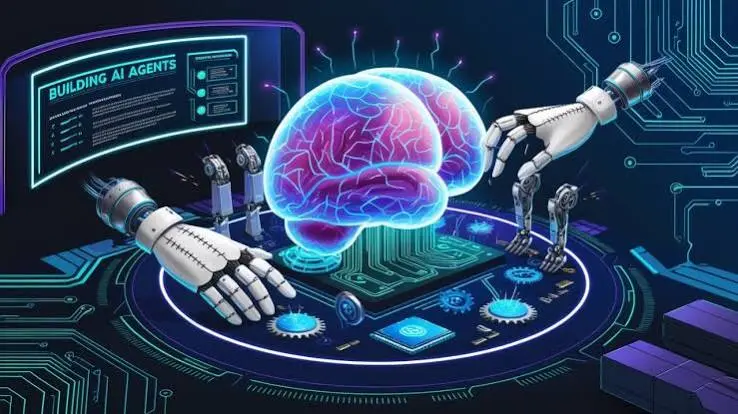
Custom AI agent development is the process of designing an AI system that can plan multi-step tasks, call your internal tools and APIs, pull live data from your business systems, and complete a workflow with minimal human input, instead of just answering questions in a chat window. Enterprise AI agent development adds the integrations, security, and monitoring needed to run that agent safely inside a company's existing tech stack, while autonomous AI agent development services focus on how much of the workflow the agent can handle without a human approving every step.
If you are evaluating an AI agent development company for your business, this guide walks through what these agents actually do, what they cost in 2026, how they compare to chatbots and off-the-shelf AI tools, and the questions worth asking before you sign a contract.
What Is an AI Agent, Really?
Most tools marketed as "AI agents" today are chatbots with a new label. They respond inside a conversation, but they don't take action outside it.
A true AI agent is different. It can:
- Understand a goal, not just a single question
- Break that goal into steps and plan an approach
- Call external tools, APIs, and databases to gather information or take action
- Make decisions along the way based on what it finds
- Complete the workflow end to end, checking in with a human only when needed
Think of the difference this way: a chatbot can tell a customer their order status if you ask it. An AI agent can check the order status, notice it's delayed, apply the correct compensation policy, update the CRM, and send the customer a message, without a person doing any of those steps manually.
AI Agent vs Chatbot vs RPA: How They Actually Compare
This is where a lot of buying decisions go wrong. Businesses often set out to buy an "AI agent" and end up with a chatbot, or they compare an agent's price to an RPA license and wonder why it costs more. Here is how the three actually differ.
| Chatbot | RPA (Robotic Process Automation) | AI Agent | |
| Handles | Conversation, FAQs | Fixed, rule-based steps | Multi-step goals with judgment calls |
| Adapts to change | No, scripted responses | No, breaks if the UI or process changes | Yes, reasons through new situations |
| Uses tools/APIs | Rarely, or only one | Yes, but only pre-programmed steps | Yes, chooses which tool to use and when |
| Decision-making | None | None | Plans and adjusts based on context |
| Best for | Support deflection, FAQs | Repetitive, unchanging back-office tasks | Workflows that involve judgment, multiple systems, or changing inputs |
| Typical starting cost (2026) | $5K to $20K | $10K to $40K per bot | $15K to $500K depending on complexity |
If your process rarely changes and follows the exact same steps every time, RPA is often cheaper and sufficient. If your process requires judgment, spans multiple systems, or needs to handle exceptions, that's where custom AI agent development earns its cost.
Why Enterprise AI Agent Development Is Accelerating in 2026
This isn't a hype cycle anymore, it shows up in the adoption numbers. A few data points worth knowing if you're building a business case internally:
- The global AI agents market is estimated at roughly $10.9 billion in 2026, up from about $7.6 billion in 2025.
- Gartner projects that 40% of enterprise applications will include task-specific AI agents by the end of 2026, up from under 5% in 2025.
- Around 79% of enterprises have adopted AI agents in some form, but only about 11% are running them in production, a gap that usually comes down to weak integration, unclear ownership, or agents built as demos instead of production systems.
- Among enterprises with agents in production, banking and insurance lead adoption at roughly 47%, while healthcare and government trail at 14% to 18%, largely due to compliance requirements.
- BCG and Forrester research from 2026 puts the median time-to-value for an AI agent deployment at about 5.1 months, with simpler agents (like SDR or lead-qualification agents) paying back in as little as 3.4 months.
- Gartner also warns that roughly 40% of agentic AI projects will be cancelled before 2027, usually because the scope was too broad, the ROI case was unclear, or the agent was never connected to real business systems.
The takeaway: the businesses seeing real returns are the ones who scope a specific, well-defined workflow first, rather than trying to build one agent that does everything.
Types of AI Agent Development Services
"AI agent development" isn't one single service. Depending on your goal, you're usually looking at one (or a mix) of these:
Custom AI Agent Development
Built around your specific process, tools, and data, rather than a generic template. This is the right starting point when your workflow doesn't map cleanly onto an off-the-shelf product, or when the process touches proprietary data you can't hand to a third-party platform.
Enterprise AI Agent Development
Adds what a large organization actually needs on top of the agent itself: integration with CRMs, ERPs, and internal databases, single sign-on, role-based access, audit logging, and infrastructure that can handle production-level traffic without breaking compliance requirements.
Autonomous AI Agent Development Services
Focused on how independently the agent can operate. A low-autonomy agent drafts an action and waits for a human to approve it. A high-autonomy agent completes the action itself and only escalates exceptions. Most companies start with lower autonomy and expand it once the agent has a track record.
Custom AI Agent Development vs Off-the-Shelf AI Tools
This is usually the real decision businesses are weighing, not "chatbot vs agent," but "buy a ready-made tool vs build something custom."
| Factor | Off-the-Shelf AI Tool | Custom AI Agent Development |
| Time to launch | Days to a few weeks | 6 to 16+ weeks depending on scope |
| Upfront cost | Low ($20 to $50/user/month typically) | Higher ($15K to $500K depending on complexity) |
| Fit to your process | Generic, you adapt your workflow to the tool | Built around your exact workflow and systems |
| Data ownership | Often shared with the vendor's platform | Stays within your infrastructure |
| Integration depth | Limited to supported integrations | Connects to any internal tool or legacy system via API |
| Scalability | Capped by vendor's roadmap and pricing tiers | Built to scale with your business and specific needs |
| 3-year total cost | Can exceed custom build if usage or seats scale up | Often lower once the workflow is complex or high-volume |
| Best for | Simple, common use cases (basic support, scheduling) | Workflows tied to proprietary data, compliance needs, or competitive advantage |
A practical rule of thumb: rent first if you're not sure exactly what the agent needs to do. Once you know, and the workflow is central enough to your business that owning the logic matters, that's when custom AI agent development starts to pay for itself.
What Does AI Agent Development Cost in 2026?
Costs vary widely because "AI agent" covers everything from a single-purpose assistant to a multi-agent system running an entire department's workflow. Based on 2026 industry pricing data:
| Project Type | Typical Cost Range | What's Included |
| Simple MVP agent | $15,000 to $60,000 | Off-the-shelf LLM, basic tool access, one workflow |
| Production single-agent system | $60,000 to $200,000 | Orchestration, security, monitoring, multiple integrations |
| Enterprise multi-agent system | $150,000 to $500,000+ | Compliance (SOC 2, HIPAA), fine-tuning, high-scale infrastructure |
| Ongoing maintenance | 15% to 25% of build cost annually | Monitoring, retraining, updates, support |
Ask any AI agent development company for a breakdown by these categories. If a quote doesn't separate build cost from ongoing maintenance, that's worth clarifying before you sign anything, since the monthly infrastructure and monitoring costs (often $1,000 to $15,000/month) can add up faster than the initial build.
How to Choose an AI Agent Development Company
A few questions worth asking before you commit to a vendor:
- Can they show a working agent, not a demo? Ask what happens when the agent hits an edge case it wasn't trained for.
- Do they design for your existing systems, or expect you to change your process? Custom AI agent development should plug into your CRM, ERP, or internal tools, not force a workaround.
- What guardrails do they build in? Look for scoped tool access, approval checkpoints for sensitive actions, and logging, so an autonomous AI agent stays auditable once it's live.
- What happens after launch? Agents drift as your data and processes change. Ask about their monitoring, retraining, and optimization process, not just the build.
- Can they explain their process in plain terms? A vendor who can clearly walk you through discovery, design, testing, deployment, and monitoring is usually more reliable than one who jumps straight to a proposal.
If you're comparing vendors, our guide on how to evaluate an AI automation company covers a broader framework that applies to agent projects too.
Real-World Use Cases for Autonomous AI Agents
AI agents tend to earn their keep fastest in workflows that involve repetitive judgment calls across multiple systems:
- Healthcare: Patient scheduling, intake triage, and administrative follow-ups
- Real estate: Lead qualification, property matching, and client follow-up sequences
- Ecommerce: Order tracking, personalized recommendations, and support ticket triage
- Logistics: Shipment tracking, route planning, and warehouse coordination
- SaaS and startups: Product-embedded agents that handle onboarding or usage-based support
These map closely to the kind of business process automation and AI automation work that typically comes before an agent project, since a workflow usually needs to be mapped and partially automated before it's ready for an autonomous agent to take over.
The AI Agent Development Process
Most reliable AI agent development companies follow a version of this sequence:
- Discovery and use case mapping. Understand the workflow, data sources, tools, and edge cases the agent needs to handle.
- Agent design and development. Build the agent's reasoning, tool access, and integrations with existing systems.
- Testing and deployment. Test agent behavior against real scenarios before it touches live data or customers.
- Monitoring and optimization. Track performance, retrain as needed, and expand autonomy gradually as trust builds.
This is also roughly how our own AI agent development engagements are structured, starting with a scoped workflow rather than a blank-slate "build us an AI agent" brief.
Frequently Asked Questions
What is the difference between AI agent development and AI automation?
AI automation covers a broader range of tools that streamline tasks, including rule-based workflows and simpler scripts. AI agent development specifically builds systems that can reason, plan, and make decisions across multiple steps, not just execute a fixed sequence.
How long does custom AI agent development take?
A simple, single-workflow agent can launch in 6 to 8 weeks. Enterprise systems with multiple integrations and compliance requirements typically take 12 to 20+ weeks.
Is autonomous AI agent development safe for sensitive business processes?
It can be, when the agent is built with scoped permissions, approval checkpoints for high-risk actions, and audit logging. Most companies start with a lower level of autonomy and expand it as the agent proves reliable.
Do enterprise AI agents work with legacy systems?
Yes, in most cases. Enterprise AI agent development typically connects through APIs, and where a legacy system lacks a clean API, developers can often build a middleware layer to bridge the gap.
What's the difference between a single AI agent and a multi-agent system?
A single agent handles one workflow end to end. A multi-agent system uses several specialized agents that hand tasks off to each other, useful for complex processes that span multiple departments or decision types.
How much does an AI agent development company charge?
Based on 2026 market data, costs range from around $15,000 for a simple MVP to $500,000+ for enterprise multi-agent systems, with most mid-sized projects landing between $60,000 and $200,000.
Choosing the Right Partner for Your AI Agent Project
The gap between companies that get real value from AI agents and the ones whose projects stall usually isn't the technology. It's scope. Agents that fail tend to be built as "do everything" experiments; agents that succeed start with one clearly defined workflow, prove it, then expand.
If you're scoping a custom AI agent development project, an enterprise integration, or an autonomous workflow, it helps to start with a short discovery conversation rather than a full proposal. You can see how our team approaches this on the AI agent development page, or get in touch to talk through your specific use case.
Ready to start your project?